


Views: 0 Author: Site Editor Publish Time: 2026-02-04 Origin: Site


The global coatings industry is undergoing a massive shift toward sustainability, with water-based systems leading the charge. As manufacturers move away from solvent-based formulas to reduce Volatile Organic Compounds (VOCs), the demand for high-performance additives has skyrocketed. Among these, Paint Grade CMC (Sodium Carboxymethyl Cellulose) has emerged as a cornerstone ingredient, ensuring that eco-friendly paints do not compromise on quality or application ease.
Paint Grade CMC serves as a multifunctional additive in water-based paints, primarily acting as a thickener, stabilizer, and rheology modifier that ensures uniform pigment distribution, prevents sagging, and enhances the overall shelf life of the coating product. By leveraging the unique chemical properties of sodium carboxymethyl cellulose, manufacturers can achieve a perfect balance between liquid stability and dry-film performance.
Understanding how carboxymethyl cellulose cmc interacts with other paint components is vital for any industrial chemist or B2B procurement specialist. This article provides an in-depth exploration of the mechanisms, advantages, and industrial applications of this versatile polymer. We will delve into how Paint Grade CMC optimizes the production process and why it remains a preferred choice for high-volume manufacturing.
CMC in Water-Based Paints and Coatings
The Role of CMC in Water-Based Paints
Benefits of CMC in Water-Based Paints
Applications of CMC in Water-Based Coatings
Case Study: CMC in Exterior Paints
Conclusion
In the context of modern chemical formulations, Paint Grade CMC is a water-soluble cellulose ether derived from natural wood pulp or cotton linters, specifically engineered to provide viscosity control and water retention in aqueous coating systems. This polymer is prized for its high purity and consistent performance across various pH levels, making it a reliable backbone for both architectural and industrial paints.
The chemical structure of sodium carboxymethyl cellulose allows it to dissolve quickly in water, forming a clear, viscous solution. In water-based paints, which consist of pigments, binders, and additives dispersed in a water medium, Paint Grade CMC acts as a protective colloid. This prevents the heavier pigment particles from settling at the bottom of the container, a common issue known as "hard caking." By maintaining a stable suspension, the additive ensures that the paint is ready for use with minimal stirring, even after months of storage.
Furthermore, the integration of carboxymethyl cellulose cmc into coatings addresses the challenge of syneresis—the separation of liquid from the gel structure. Because Paint Grade CMC binds water molecules effectively, it keeps the formulation homogeneous. This water-retention capability is also crucial during the application phase; it prevents the paint from drying too quickly on porous surfaces, allowing the user more "open time" to brush out streaks or lap marks.
The versatility of Paint Grade CMC extends to its compatibility with other thickeners like HPMC or synthetic acrylics. While many thickeners focus solely on viscosity, sodium carboxymethyl cellulose provides a unique rheological profile that improves "spatter resistance." When a roller is used to apply paint, the presence of carboxymethyl cellulose cmc helps the liquid resist breaking into tiny droplets, leading to a cleaner workspace and a more uniform coating thickness on the wall.
The primary role of Paint Grade CMC is to function as a rheology modifier that dictates the flow behavior of the paint, ensuring it is thick enough to stay on the brush but fluid enough to spread evenly across a substrate. Beyond simple thickening, sodium carboxymethyl cellulose coordinates the interaction between the latex binder and the pigment particles, creating a stable internal matrix.
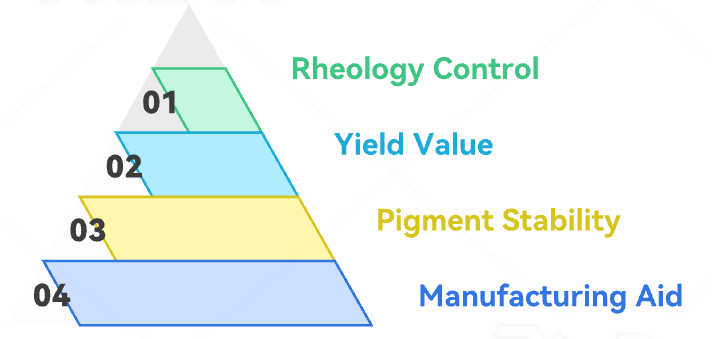
One of the most critical roles of carboxymethyl cellulose cmc is controlling the "Yield Value" of the paint. The yield value is the amount of force required to get the paint moving. A high yield value provided by Paint Grade CMC means the paint won't drip off the brush or run down the wall after application. However, because sodium carboxymethyl cellulose is pseudoplastic, the viscosity drops as soon as you apply shear (like brushing), making the application feel smooth and effortless.
In addition to rheology, Paint Grade CMC plays a vital role in pigment stabilization. Pigments like Titanium Dioxide are heavy and prone to clumping (flocculation). The molecules of carboxymethyl cellulose cmc adsorb onto the surface of these pigment particles, providing steric hindrance that keeps them separated. This ensures that the color remains vibrant and uniform, preventing "flooding" or "floating" where certain colors migrate to the surface of the wet film.
The role of Paint Grade CMC also extends to the manufacturing stage. During the "grind" phase of paint production, sodium carboxymethyl cellulose helps to lubricate the pigment particles, making them easier to disperse in the water phase. This reduces the energy required for mixing and shortens production times. By ensuring a fine dispersion from the start, carboxymethyl cellulose cmc contributes to the long-term quality and consistency of every batch produced.
| Function | Description of Impact | Benefit to User |
| Thickening | Increases the "body" of the liquid paint. | Prevents drips and spills during use. |
| Water Retention | Slows the evaporation of water from the wet film. | Extends open time for a better finish. |
| Suspension | Keeps pigments and fillers from settling. | Eliminates the need for heavy stirring. |
| Film-Forming | Assists in creating a continuous dry layer. | Increases the durability of the paint. |
The benefits of incorporating Paint Grade CMC into water-based paints include enhanced shelf stability, superior brushability, increased water retention, and a significant reduction in overall formulation costs. As a bio-based polymer, sodium carboxymethyl cellulose also offers an environmentally friendly profile that aligns with the "green" initiatives of modern paint manufacturers.
Cost-efficiency is perhaps the most immediate benefit for B2B buyers. Compared to synthetic associative thickeners or HEC (Hydroxyethyl Cellulose), Paint Grade CMC provides a high level of thickening power at a lower price point. Because carboxymethyl cellulose cmc is highly effective even at low concentrations (typically 0.1% to 1.5% of the total formulation), manufacturers can achieve the desired viscosity while keeping raw material costs under control.
Another major benefit is the improvement in "leveling" and "sag resistance." A common problem in water-based coatings is that if the paint dries too fast or stays too thick, brush marks remain visible. Paint Grade CMC allows the paint to remain fluid enough for a few minutes after application to "level out" those marks, but then quickly builds up internal strength to prevent the paint from "sagging" or running down the wall. This balance is difficult to achieve without high-quality sodium carboxymethyl cellulose.
From a performance standpoint, Paint Grade CMC enhances the scrub resistance of the final coating. When the paint dries, the carboxymethyl cellulose cmc integrates into the binder matrix, helping to bridge gaps between particles. This results in a tougher, more cohesive film that can withstand washing and everyday wear. Additionally, Paint Grade CMC is resistant to oils and organic solvents, which helps the paint resist staining once it has fully cured.
Eco-Friendly: Derived from renewable cellulose sources.
High Compatibility: Works well with various latex binders (Acrylic, VAE, SBR).
Excellent Transparency: Does not affect the final color or clarity of the paint.
Bio-Stability: Modern grades are treated to resist enzymatic degradation.
Paint Grade CMC is utilized across a wide spectrum of applications, ranging from interior decorative emulsions and exterior masonry paints to specialized industrial primers and textile coatings. Its ability to function across different temperatures and humidity levels makes sodium carboxymethyl cellulose a global standard for various environmental conditions.
In interior emulsion paints, Paint Grade CMC is the go-to additive for achieving a smooth, matte, or silk finish. Interior paints require high "opacity" or hiding power, which depends on perfect pigment dispersion. The use of carboxymethyl cellulose cmc ensures that the titanium dioxide and extenders (like calcium carbonate) are evenly spread, allowing a single coat of paint to cover dark colors effectively. The non-toxic nature of sodium carboxymethyl cellulose also makes it ideal for indoor residential use.
Exterior coatings represent another major application area. These paints must withstand harsh UV rays, rain, and temperature fluctuations. Paint Grade CMC provides the necessary water retention to ensure the paint doesn't dry too fast in direct sunlight, which could cause cracking. Furthermore, the stabilization properties of carboxymethyl cellulose cmc ensure that the large amounts of anti-fungal and anti-algal additives usually found in exterior paints remain evenly distributed throughout the product life.
Beyond architectural paints, Paint Grade CMC is used in paper coatings and textile printing pastes. In these industries, the polymer controls the "strike-through" of the ink or paint, ensuring it stays on the surface of the material rather than soaking in. This same principle is applied in water-based wood stains and primers, where sodium carboxymethyl cellulose helps the coating adhere to the surface fibers, providing a uniform base for the topcoat.
A practical case study involving a mid-sized paint manufacturer demonstrated that switching to a specialized Paint Grade CMC increased their production efficiency by 15% while reducing customer complaints regarding paint sagging by 40%. The manufacturer was struggling with a high-build exterior masonry paint that frequently separated in the warehouse and was difficult for contractors to apply in warm weather.
The technical team introduced a high-purity sodium carboxymethyl cellulose with a specific degree of substitution to the formula. By replacing a portion of the expensive synthetic thickeners with Paint Grade CMC, they achieved a more robust rheological profile. The carboxymethyl cellulose cmc allowed the paint to hold more "solids" (pigment and filler) without becoming unmanageable. This meant that the paint provided better coverage with fewer coats, a major selling point for professional painters.
During the testing phase, the exterior paint formulated with Paint Grade CMC was applied to a south-facing concrete wall in 30°C heat. While the previous formulation dried almost instantly, leading to visible lap marks, the new formula containing sodium carboxymethyl cellulose remained workable for several minutes longer. This allowed the painters to maintain a "wet edge," resulting in a seamless, professional finish across the entire surface.
The long-term results were equally impressive. After six months of storage in varying temperatures, the paint batches containing carboxymethyl cellulose cmc showed no signs of syneresis or pigment settling. The manufacturer was able to market a more stable, higher-performing product at a lower cost per liter. This case study highlights how Paint Grade CMC is not just a filler, but a strategic component that solves real-world application and storage challenges.
In summary, Paint Grade CMC is an essential multi-purpose additive that defines the quality, stability, and usability of modern water-based paints and coatings. Through its roles as a thickener, stabilizer, and water-retention agent, sodium carboxymethyl cellulose ensures that formulations meet the high expectations of both DIY consumers and professional contractors.
The strategic use of carboxymethyl cellulose cmc allows manufacturers to create products that are both high-performing and cost-effective. By optimizing the rheology of the paint, Paint Grade CMC bridges the gap between the liquid state in the can and the durable, aesthetic film on the wall. As the industry continues to move toward more sustainable, water-borne technologies, the importance of high-quality sodium carboxymethyl cellulose will only continue to grow.


