


Views: 0 Author: Site Editor Publish Time: 2026-02-02 Origin: Site


In the competitive landscape of the global coatings industry, the pursuit of superior paint performance begins with the selection of high-performance chemical additives. Among the most critical components in water-based systems is sodium carboxymethyl cellulose, commonly known as CMC. As an anionic, water-soluble polymer derived from natural cellulose, CMC has transformed the manufacturing process by providing multi-functional benefits that range from rheology modification to pigment stabilization. For B2B manufacturers and paint formulators, understanding the technical nuances of Paint Grade CMC is essential for producing coatings that meet modern standards for ease of application and environmental sustainability.
CMC is used in paint formulations primarily as a high-efficiency thickener and rheology modifier that ensures uniform viscosity, prevents pigment sedimentation, and improves the overall application workability by reducing spattering and sagging.
By integrating carboxymethyl cellulose cmc into a formulation, manufacturers can achieve a delicate balance between a paint's storage stability and its behavior during application. Whether used in architectural latex paints, industrial waterborne coatings, or specialized decorative finishes, this cellulose derivative acts as a protective colloid that maintains the integrity of the emulsion system. The following sections provide a comprehensive analysis of the color matching techniques, thickening advantages, and long-term durability impacts associated with Paint Grade CMC.
Color Matching Techniques for CMC in Paint Formulations
Benefits of Using CMC as a Thickener in Paint Formulations
Impact of CMC on Paint Performance and Durability
Q&A: Common Inquiries Regarding Paint Grade CMC
Color matching techniques for CMC in paint formulations focus on utilizing its excellent dispersant properties to ensure that pigments and fillers are uniformly suspended, thereby preventing color floating and ensuring shade consistency across different batches.
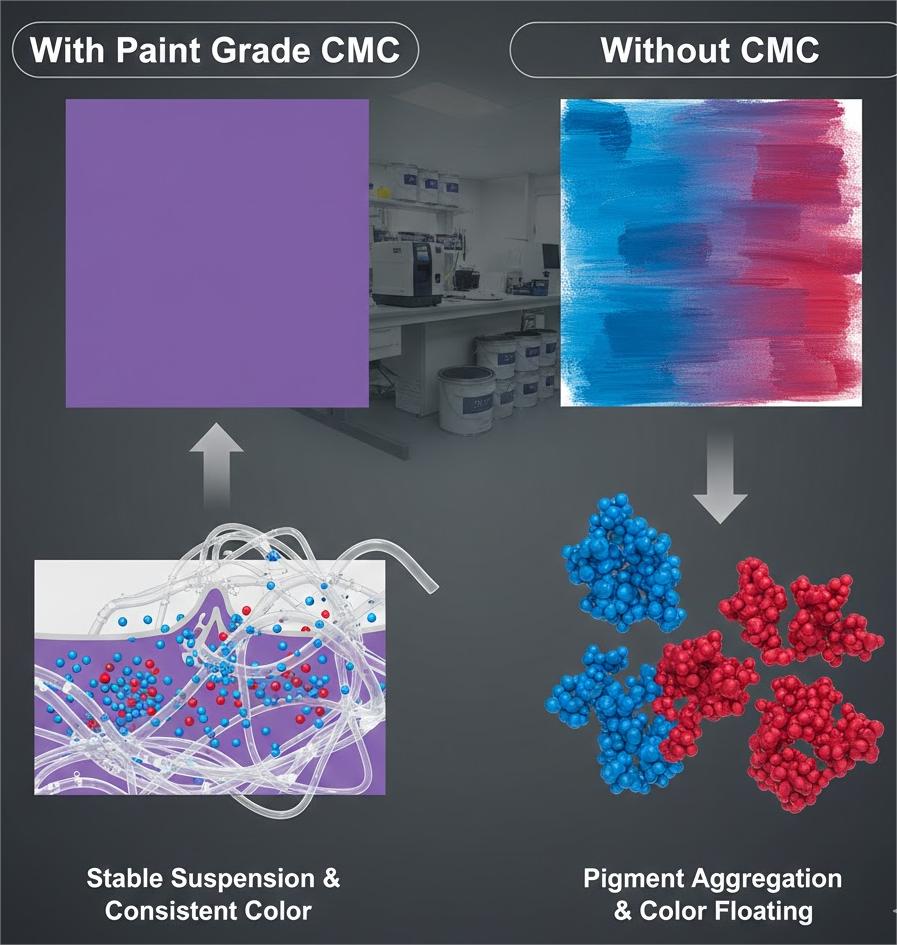
In high-volume B2B paint production, color consistency is non-negotiable. Paint Grade CMC plays a pivotal role here by acting as a powerful dispersing agent. When pigments are added to a water-based system, they naturally tend to clump or aggregate. The anionic nature of sodium carboxymethyl cellulose allows it to coat these pigment particles, creating an electrostatic repulsion that keeps them separated. This ensures that the colorants are "unlocked" and fully developed within the liquid matrix, leading to higher color strength and more vibrant hues.
Furthermore, the stability provided by carboxymethyl cellulose cmc prevents a common issue known as "color floating" or "mottling." This occurs when different pigments in a blend separate during the drying process, leading to uneven streaks or spots on the wall. By controlling the viscosity and maintaining a stable suspension, CMC ensures that the pigment distribution remains homogeneous from the moment the can is opened until the film is completely dry. This is particularly vital for custom tinting systems where precision is paramount.
Technicians also leverage the pH stability of sodium carboxymethyl cellulose during the color matching process. Most water-based latex paints operate in an alkaline environment (typically pH 8 to 10). Unlike some organic thickeners that might degrade or lose efficiency at high pH, Paint Grade CMC maintains its structural integrity. This stability allows formulators to predict color outcomes accurately without worrying about viscosity drops that could alter how the paint reflects light or hides the substrate beneath it.
The benefits of using CMC as a thickener in paint formulations include superior rheological control, high thickening efficiency at low concentrations, and a unique shear-thinning behavior that facilitates smooth brushing and roller application.
One of the primary reasons for selecting Paint Grade CMC is its remarkable thickening efficiency. Even at a low dosage (often less than 1% of the total formulation), it can significantly increase the viscosity of a water-based system. This is achieved through the entanglement of its long molecular chains and the hydration of its carboxymethyl groups, which create a dense, colloidal network. For manufacturers, this high efficiency translates to a lower "cost-per-gallon" compared to many synthetic associative thickeners.
| Feature | Paint Grade CMC | Guar Gum / Starch | Synthetic HEUR Thickeners |
| Thickening Efficiency | High | Moderate | Very High |
| Shear-Thinning | Excellent | Poor | Variable |
| Biological Stability | Resistant | Low (prone to rot) | High |
| Cost Effectiveness | Superior | High | Low |
| Compatibility | Broad | Limited | Specific |
The "shear-thinning" or pseudoplastic property of carboxymethyl cellulose cmc is perhaps its most valued trait by professional painters. When the paint is under high stress—such as being pushed by a brush or spun by a roller—the CMC molecules align, causing the viscosity to drop instantly. This allows the paint to flow easily and cover the surface with minimal effort. However, once the stress is removed, the viscosity recovers rapidly, preventing the paint from "sagging" or "dripping" down the wall.
Beyond application ease, sodium carboxymethyl cellulose acts as an anti-spattering agent. During roller application, traditional paints can "fling" tiny droplets of liquid, creating a mess for the contractor. The cohesive strength provided by the CMC network holds the liquid together more effectively on the roller, ensuring that the paint stays on the surface rather than the floor. This improves the overall workability and professional quality of the coating.
The impact of CMC on paint performance and durability is evidenced by enhanced film-forming properties, improved water resistance of the dried coating, and a significant extension of the product's shelf life through the prevention of pigment settling.
The quality of the final dried film is where Paint Grade CMC truly proves its worth. As the water evaporates from the wet paint, the CMC aids in the coalescence of the latex particles, helping them fuse into a continuous, tough film. This film is not only more uniform in appearance but also exhibits better mechanical strength. Because carboxymethyl cellulose cmc provides excellent water retention during the drying phase, it prevents the "open time" from being too short, allowing the paint to level out and eliminate brush marks before it sets.
Adhesion Promotion: The polar groups in sodium carboxymethyl cellulose create strong hydrogen bonds with various substrates, including concrete, masonry, and wood, reducing the risk of peeling.
Scrub Resistance: By creating a more cohesive film structure, CMC helps the paint withstand repeated cleaning and mechanical abrasion.
Alkali Resistance: Its stability in high-pH environments makes it the ideal additive for masonry paints applied to "fresh" concrete or plaster.
Durability also applies to the paint while it is still in the container. Without a proper stabilizer like Paint Grade CMC, heavy pigments and mineral fillers would settle to the bottom of the can over time, forming a "hard cake" that is nearly impossible to stir back in. CMC creates a yield stress within the liquid that supports these heavy particles, keeping them in permanent suspension. This ensures that a gallon of paint purchased today will perform exactly the same way six months or a year from now, which is a critical factor for B2B distributors and retailers.
Furthermore, modern sodium carboxymethyl cellulose is engineered to be resistant to enzymatic and bacterial attack. In the past, cellulose-based thickeners were a food source for microbes, leading to "spoilage" and foul odors in the paint can. Today's high-purity carboxymethyl cellulose cmc grades undergo rigorous treatment to ensure they remain stable under various storage conditions, protecting the manufacturer's reputation and reducing the need for excessive amounts of biocidal additives.
Yes, sodium carboxymethyl cellulose is derived from natural wood pulp or cotton linters. It is non-toxic, biodegradable, and renewable, making it a preferred choice for "Green" or low-VOC paint formulations. Unlike some petroleum-based synthetic thickeners, CMC aligns with global sustainability initiatives.
The DS of carboxymethyl cellulose cmc refers to the number of carboxymethyl groups attached to the cellulose chain. For paint applications, a DS between 0.7 and 1.2 is typical. A higher DS generally results in better water solubility and greater resistance to salts and acids, ensuring the paint remains stable in diverse environmental conditions.
Absolutely. Paint Grade CMC is highly versatile. In interior paints, it provides the "washability" and smooth finish consumers expect. In exterior paints, its ability to improve film density and UV stability helps the coating withstand harsh weather, moisture, and temperature fluctuations.
The role of Paint Grade CMC in the coatings industry cannot be overstated. From its humble origins as a cellulose derivative to its current status as a sophisticated rheology modifier, sodium carboxymethyl cellulose provides the structural foundation for high-quality water-based paints. By offering superior thickening efficiency, ensuring perfect color development, and enhancing the long-term durability of the finished film, CMC addresses the most significant challenges faced by paint formulators today.
For B2B manufacturers, the integration of carboxymethyl cellulose cmc is a strategic decision that affects both product performance and the bottom line. It allows for the creation of paints that are easier to apply, more stable during storage, and more resistant to the rigors of the environment. As the industry continues to move toward more sustainable and eco-friendly solutions, the importance of this bio-based polymer will only continue to grow.


