


 | 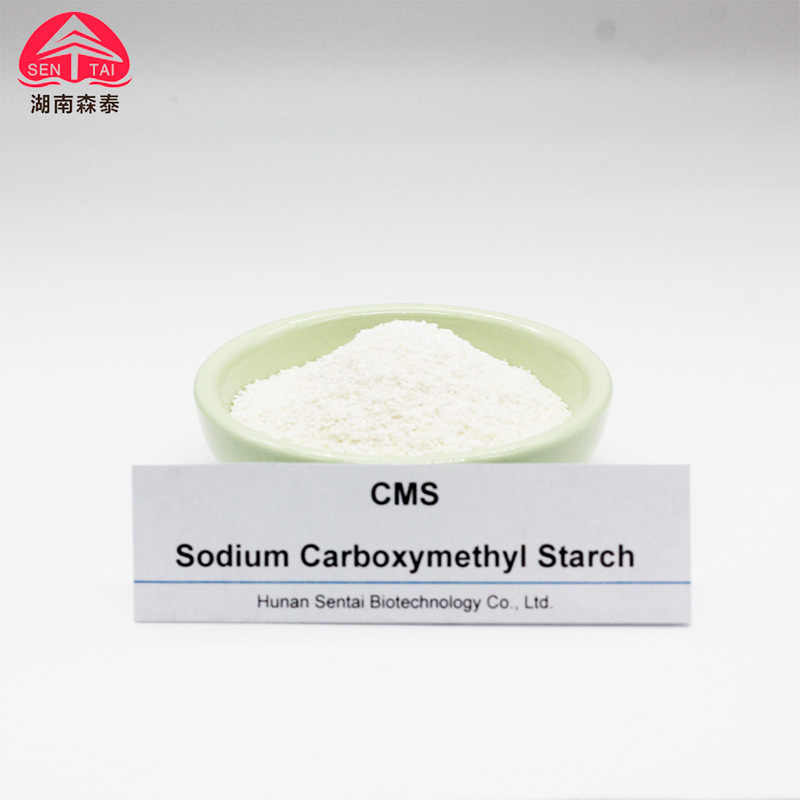 |
| CMS | Sodium Carboxymethyl Starch |
Product Overview
CMS Carboxymethyl Starch Sodium (CMS-Na) is a high-performance, water-soluble starch derivative engineered for industrial applications. Renowned for its exceptional thickening, binding, and stabilizing properties, CMS-Na serves as a sustainable and cost-effective alternative to synthetic polymers. Its biodegradability and non-toxic nature make it ideal for industries prioritizing eco-friendly solutions.
Key Features
• High Water Solubility: Rapid dissolution in cold or hot water for easy integration into processes.
• Enhanced Viscosity Control: Adjustable viscosity to meet diverse industrial requirements.
• Superior Adhesion & Film-Forming: Ensures durable bonding and surface cohesion.
• pH Stability: Performs consistently across acidic to alkaline environments.
• Biodegradable & Non-Toxic: Aligns with green manufacturing standards.
Industrial Applications
1. Papermaking Industry
CMS-Na is a versatile additive in paper production, delivering:
• Strength Enhancement: Improves dry and wet tensile strength of paper, reducing breakage during processing.
• Retention Aid: Boosts retention of fillers and fine fibers, optimizing material usage and reducing costs.
• Drainage Improvement: Accelerates dewatering on the wire section, enhancing production efficiency.
• Surface Smoothness: Forms a uniform coating layer for high-quality printing finishes.
Recommended for: Packaging paper, cardboard, specialty papers, and recycled paper production.
2. Textile Industry
CMS-Na excels as a multifunctional auxiliary in textile manufacturing:
• Sizing Agent: Strengthens yarns, reduces friction during weaving, and improves loom efficiency.
• Printing Thickener: Ensures sharp, vibrant prints by preventing dye migration on fabrics.
• Eco-Friendly Sizing: Easily removed during desizing, minimizing water consumption and pollution.
• Fabric Finishing: Enhances hand feel and stiffness control for tailored fabric properties.
Recommended for: Cotton, polyester blends, and sustainable textile processing.
3. Wallpaper Adhesive & Construction
CMS-Na is a key component in high-performance adhesives for:
• Strong Initial Tack: Ensures instant adhesion during wallpaper installation.
• Long-Term Stability: Resists moisture and temperature fluctuations, preventing peeling.
• Mold Resistance: Inhibits microbial growth in humid environments.
• Non-Toxic Formula: Safe for indoor use with low VOC emissions.
Recommended for: Vinyl wallpapers, paper-backed textiles, and eco-friendly adhesives.
Additional Applications
• Ceramics: Binder for green strength in molding.
• Detergents: Anti-redeposition agent in powder formulations.
• Water Treatment: Flocculant for wastewater clarification.
Why Choose Our CMS-Na?
• Customizable Grades: Tailored viscosity, substitution degree, and particle size for your needs.
• Technical Support: End-to-end assistance from R&D to large-scale production.
• Consistent Quality: Rigorous QC ensures batch-to-batch reliability.
• Sustainable Sourcing: Derived from renewable starch resources.
Specifications
Parameter | Range |
Substitution Degree | 0.3–0.8 |
Viscosity (2% sol.) | 100–5000 mPa·s |
pH (1% solution) | 6.5–8.5 |
Moisture Content | ≤10% |
*We can customize according to the client's required specifications.
CMS Sodium Carboxymethyl Starch, also known as CMS-Na, is a high-performance water-soluble starch derivative engineered for industrial applications. It is used as a thickener, binder, stabilizer, adhesive, film-forming agent, retention aid, sizing agent, printing thickener, and flocculant in different production systems.
With high water solubility, adjustable viscosity, adhesion, film-forming ability, pH stability, and biodegradable performance, CMS-Na is suitable for industries that require functional, process-friendly, and cost-effective polymer additives.
Parameter | Range |
|---|---|
Substitution Degree | 0.3–0.8 |
Viscosity, 2% Solution | 100–5000 mPa·s |
pH, 1% Solution | 6.5–8.5 |
Moisture Content | ≤10% |
CMS-Na is derived from starch and modified to improve water solubility and industrial functionality. Compared with many conventional synthetic polymers, it provides a more sustainable and cost-effective option for applications that require thickening, bonding, stabilization, and surface cohesion.
Its performance can be adjusted through viscosity, substitution degree, and particle size, allowing the product to match different processing systems and end-use requirements.
CMS-Na dissolves rapidly in cold or hot water, making it easy to integrate into industrial processes. This supports convenient preparation and helps improve processing efficiency.
CMS Sodium Carboxymethyl Starch provides viscosity control for different industrial requirements. The viscosity range can be adjusted according to the specific formulation and application process.
CMS-Na offers adhesion and film-forming properties. It helps improve bonding, surface cohesion, and coating performance in suitable applications.
CMS-Na performs consistently across acidic to alkaline environments, making it suitable for a range of industrial formulation systems.
CMS Sodium Carboxymethyl Starch is biodegradable and non-toxic, making it suitable for industries that prioritize environmentally friendly solutions.
CMS-Na is used as a versatile additive in paper production. It helps improve paper strength, material retention, drainage performance, and surface quality.
In papermaking applications, CMS-Na can improve dry and wet tensile strength, reducing breakage during processing. It can also help increase the retention of fillers and fine fibers, supporting material utilization and cost control.
CMS-Na also supports drainage improvement by accelerating dewatering on the wire section, which helps improve production efficiency. When used for surface performance, it forms a uniform coating layer that supports high-quality printing finishes.
Packaging paper
Cardboard
Specialty papers
Recycled paper production
Improves dry and wet tensile strength
Helps reduce paper breakage during processing
Boosts retention of fillers and fine fibers
Supports material utilization and cost control
Accelerates dewatering on the wire section
Helps improve production efficiency
Forms a uniform coating layer
Supports high-quality printing finishes
CMS Sodium Carboxymethyl Starch can be used as a multifunctional auxiliary in textile manufacturing. It works as a sizing agent, printing thickener, eco-friendly sizing material, and fabric finishing aid.
As a sizing agent, CMS-Na strengthens yarns, reduces friction during weaving, and improves loom efficiency. As a printing thickener, it helps prevent dye migration on fabrics, supporting sharp and vibrant prints.
CMS-Na can also be removed during desizing, helping reduce water consumption and pollution. In fabric finishing, it helps improve hand feel and stiffness control according to different fabric requirements.
Cotton
Polyester blends
Sustainable textile processing
Strengthens yarns during weaving
Reduces friction and supports loom efficiency
Works as a textile printing thickener
Helps prevent dye migration
Supports sharp and vibrant print results
Can be removed during desizing
Helps reduce water consumption and pollution
Enhances hand feel and stiffness control
CMS-Na can be used as a key component in high-performance adhesives for wallpaper and construction-related systems. It provides adhesion, stability, mold resistance, and low-VOC formulation support.
In wallpaper adhesive applications, CMS-Na helps provide strong initial tack, allowing instant adhesion during wallpaper installation. It also supports long-term stability and helps resist moisture and temperature fluctuations, reducing the risk of peeling.
Vinyl wallpapers
Paper-backed textiles
Eco-friendly adhesives
Provides strong initial tack
Supports instant adhesion during installation
Helps resist moisture and temperature fluctuations
Helps prevent peeling
Supports mold resistance in humid environments
Suitable for non-toxic and low-VOC indoor adhesive formulas
CMS Sodium Carboxymethyl Starch can also be used in ceramics, detergents, and water treatment applications.
In ceramics, it can work as a binder for green strength in molding. In detergent powder formulations, it can function as an anti-redeposition agent. In water treatment, CMS-Na can be used as a flocculant for wastewater clarification.
Ceramic binder for green strength in molding
Anti-redeposition agent in powder detergents
Flocculant for wastewater clarification
Explore how CMS Sodium Carboxymethyl Starch supports papermaking, textile processing, wallpaper adhesives, ceramics, detergents, and water treatment applications.
Sentai can customize CMS Sodium Carboxymethyl Starch according to client requirements. Since different industries have different processing conditions and performance targets, CMS-Na specifications can be adjusted based on viscosity, substitution degree, particle size, solubility, adhesion, film-forming behavior, and application performance.
For papermaking applications, customization may focus on tensile strength improvement, filler and fine fiber retention, drainage performance, coating smoothness, and printing finish quality. For textile applications, customization may focus on yarn sizing strength, friction reduction, printing paste viscosity, dye migration control, desizing performance, fabric hand feel, and stiffness control.
For wallpaper adhesives and construction-related applications, customization may focus on initial tack, moisture and temperature stability, adhesion durability, mold resistance, and indoor-use formulation requirements. For ceramics, detergents, and water treatment, customization may focus on binding strength, anti-redeposition performance, flocculation behavior, dispersion, and processing stability.
Through technical communication, application testing, process optimization, and quality control, Sentai helps customers select and customize CMS-Na products according to their formulation system, processing method, and final product performance requirements.
CMS Sodium Carboxymethyl Starch, also known as CMS-Na, is a water-soluble starch derivative used in industrial applications as a thickener, binder, stabilizer, adhesive, film-forming agent, retention aid, sizing agent, printing thickener, and flocculant.
CMS-Na can be used in papermaking, textiles, wallpaper adhesives, construction materials, ceramics, detergents, and water treatment. It supports thickening, binding, stabilization, adhesion, film-forming, retention, drainage, sizing, printing thickening, and flocculation functions.
CMS-Na provides high water solubility, adjustable viscosity, adhesion, film-forming ability, pH stability, biodegradable performance, and non-toxic properties.
In papermaking, CMS-Na helps improve dry and wet tensile strength, reduce breakage, boost retention of fillers and fine fibers, accelerate dewatering, improve production efficiency, and form a uniform coating layer for high-quality printing finishes.
Yes. CMS-Na can be used as a sizing agent, textile printing thickener, eco-friendly sizing material, and fabric finishing auxiliary. It helps strengthen yarns, reduce friction, improve loom efficiency, prevent dye migration, and improve hand feel and stiffness control.
Yes. CMS-Na can be used in wallpaper adhesive and construction-related adhesive systems. It helps provide strong initial tack, long-term stability, moisture and temperature resistance, mold resistance, and low-VOC indoor-use formulation support.
Yes. CMS Sodium Carboxymethyl Starch can be used as a binder for green strength in ceramic molding applications.
Yes. In powder detergent formulations, CMS-Na can be used as an anti-redeposition agent.
Yes. CMS-Na can be used as a flocculant for wastewater clarification.
The listed technical specifications include substitution degree 0.3–0.8, viscosity 100–5000 mPa·s for a 2% solution, pH 6.5–8.5 for a 1% solution, and moisture content ≤10%.
Yes. Sentai can customize CMS-Na according to client requirements, including viscosity, substitution degree, particle size, solubility, adhesion, film-forming behavior, and application performance.
Customers can choose a suitable CMS-Na grade according to application type, target viscosity, substitution degree, dissolution requirements, processing conditions, and final product performance requirements. For example, papermaking may focus on strength, retention, drainage, and smoothness, while textiles may focus on sizing, printing viscosity, desizing, and fabric feel.
