


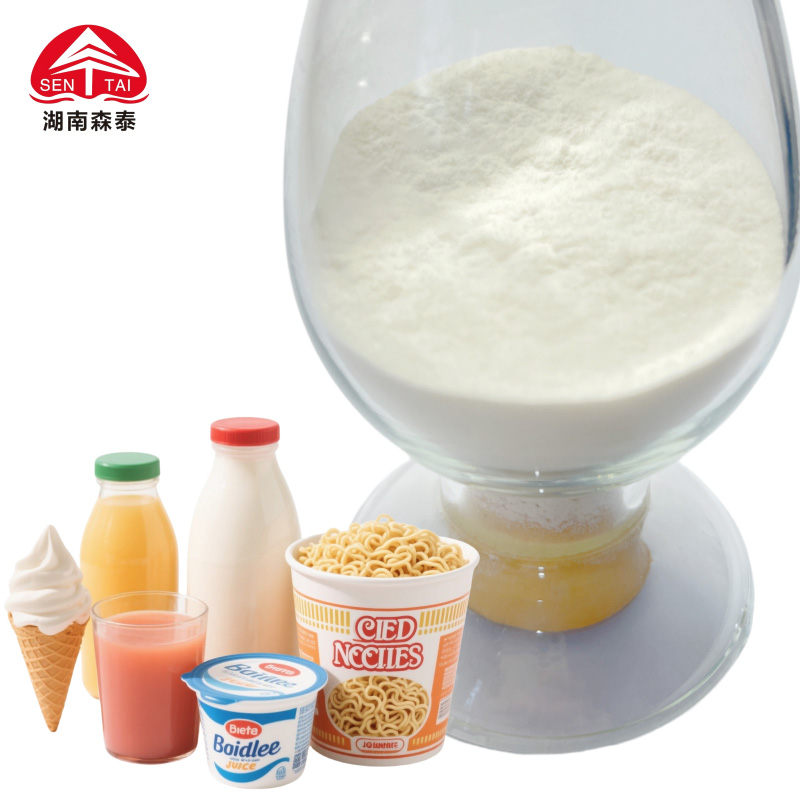
In the food industry, CMC (Sodium Carboxymethyl Cellulose) also called E466, cellulose gum, is employed as an additive, boasting multiple functions including thickening, suspending, emulsifying, stabilizing, shaping, film-forming, bulking, anti-corrosion, freshness-keeping, acid-resistance, and contributing to health protection. It can substitute for the usage of guar gum, gelatin, agar, sodium alginate, and pectin. CMC finds extensive application across a wide range of modern food products, such as frozen foods, powdered drinks, fruit juices, jams, lactic acid beverages, seasonings, biscuits, instant noodles, bakery items, and meat products.
 |  |  |
| Cellulose Gum CMC | Cellulose Gum | Cellulose Gum |
Our food grade CMC is characterized by excellent thickening properties, water-retaining capacity, dispersion stability, film-forming ability, and chemical stability. Even at low concentrations, it exhibits high viscosity, endowing food with a delicate and smooth texture. Additionally, it can mitigate food syneresis and extend the product's shelf life. In frozen foods, it controls crystal size and averts oil-water separation. In acidic systems, our acid-resistant CMC products demonstrate good suspending stability, thereby enhancing the stability of milk and the resistance of proteins. Our CMC can be combined with other stabilizers and emulsifiers, complementing each other to reinforce their effects and cut down on costs.
Application in Alcoholic Products
1. It imparts a mellow flavor, a strong aroma, and a lingering aftertaste.
2. In beer production, it serves as a foam stabilizer, enriching and prolonging the foam while enhancing the taste.
Application in Liquid Beverages
1. When used in fruit teas, fruit drinks, and vegetable juices, it suspends fruit pulp and various solids or other substances within the container, presenting a plump, uniform appearance with vibrant colors and improving the taste.
2. For neutral-flavored milk drinks like cocoa milk, it increases the viscosity of cocoa milk and prevents cocoa powder sedimentation.
3. It stabilizes beverages and extends their freshness-maintaining period.
Application in Jelly, Milk Jelly, and Jam
1. It confers appropriate thixotropy.
2. It plays a crucial part in the gelling system.
Application in Instant Noodles
1. It prevents syneresis and boosts the expansion ratio.
2. It facilitates moisture control, reduces water usage, and decreases oil content.
3. It ensures uniform products and improves the structure.
4. It gives the surface a bright and smooth finish.
Application in Bread and Cake
1. It improves the internal structure of dough and enhances its processing mechanical properties and water absorption capacity.
2. It helps the bread's honeycomb structure distribute evenly, enlarges the volume, and makes the surface shiny.
3. It inhibits starch paste from deteriorating and retrograding, thus extending the shelf life.
4. It adjusts the elasticity of the flour, preventing bread or cakes from shrinking and maintaining their shape.
Application in Quick-Frozen Cooked Wheat-based Foods and Desserts
1. Products can maintain their original state even after multiple freeze-thaw cycles.
2. It extends the freshness-keeping period.
Application in Biscuits and Pancakes
1. It improves the quality and texture of the flour and adjusts the gluten level.
2. Improves the shaping of biscuits
3. and pancakes, enhances surface smoothness, and reduces breakage rate.
4. It prevents moisture evaporation and aging, resulting in light and crispy biscuits and pancakes.
Application in Ice Cream
1. It increases the viscosity of the mixed solution, preventing the oil from floating to the surface.
2. It improves the uniformity of the system, reducing the formation of large ice crystals.
3. It strengthens the ice cream's anti-melting ability and gives it a delicate and smooth taste.
4. It reduces the use of solid ingredients, thereby lowering costs.
Application in Edible Composite Films
1. As a fundamental film-forming material, it endows the composite film with good mechanical strength, transparency, heat-sealability, printability, gas-barrier properties, and water-resistance, meeting the diverse requirements of food packaging.
2. Exhibits excellent moisture and gas barrier properties.
3. It extends the freshness-keeping period of fruits and vegetables.
Application in Brown Sour Milk Beverages
1. It reduces the product's centrifugal sedimentation rate.
2. It alleviates the whey separation phenomenon.
3. It keeps the system stable and extends the shelf life.
Application in Yogurt Products
1. It increases the thickness, improves the quality, appearance, and taste, and stabilizes the system.
2. It prevents the separation of milk serum and improves the yogurt's structure.
3. It has strong anti-sedimentation capabilities, good thermal stability, and acid-resistance.
Application in Condiments
1. It regulates viscosity, increases solid content, softens the texture, and provides a delicate and smooth taste.
2. It functions in stable emulsification, improves the quality and texture, maximizes the sensory appeal (color, aroma, and taste) of condiments, and extends the shelf life.
Special Products
1. Ultra-High-Viscosity Products: They are applicable in food industrial areas such as meat preservation, where extremely high viscosity requirements are imposed.
2. High-Transparency and Non-Fiber Products: This product has a low degree of substitution (DS ≤ 0.90), appears transparent and clear in aqueous solutions, with almost no free fibers. It not only preserves flavor similar to low-DS products but also exhibits the stability and high-transparency appearance of high-DS products.
3. Granular Products: They are designed to improve manufacturing conditions, reduce dust generation, and accelerate the dissolution rate.
★In line with the GB1886.232-2016 Food Additive Sodium Carboxymethyl Cellulose Standard
High Purity Type 6 Food Grade CMC
Model Indicators | FL6A | FM6A | FH6A | FVH6A-1 | FVH6A-2 | FVH6A-3 |
Viscosity (Brookfield, 1% soln., mPa.s) |
|
| 200-500 | 500-2000 | 2000-5000 | 25000 |
Viscosity (Brookfield, 2% soln., mPa.s) | 25-400 | 400-2000 |
|
|
|
|
pH | 6.5-8.5 | |||||
Degree of Substitution (D.S) | 0.75-0.90 | |||||
Purity (%) | ≥ 99.5 | |||||
Chloride (as NaCl, % ) | ≤0.5 | |||||
Sodium Glycolate (%) | ≤ 0.4 | |||||
Drying loss (%) | ≤ 8.0 | |||||
As/(mg/kg) | ≤2.0 | |||||
Pb/(mg/kg) | ≤2.0 | |||||
Total number of colonies (cfu/g) | ≤ 500 | |||||
Total number of molds and yeasts (cfu/g) | ≤100 | |||||
Escherichia coli (cfu/g) | Not to be detected | |||||
Salmonella (cfu/g) | Not to be detected | |||||
Staphylococcus aureus (cfu/g) | Not to be detected | |||||
High purity 9 Type Food Grade CMC
Model Indicators | FL9A | FM9A | FH9A | FVH9A-1 | FVH9A-2 | FVH9A-3 | FL10A |
Viscosity (Brookfield, 1% soln., mPa.s) |
|
| 200-500 | 500-2000 | 2000-4000 | ≥ 4000 |
|
Viscosity (Brookfield, 2% soln., mPa.s) | 25-400 | 400-2000 |
|
|
|
| 25-400 |
pH | 6.5-8.5 | ||||||
Degree of Substitution (D.S) | ≥ 0.92 | ≥ 0.90 | ≥ 1.0 | ||||
Purity (%) | ≥ 99.5 | ||||||
Chloride (as NaCl, % ) | ≤0.5 | ||||||
Sodium Glycolate (%) | ≤ 0.4 | ||||||
Drying loss (%) | ≤ 8.0 | ||||||
As/(mg/kg) | ≤2.0 | ||||||
Pb/(mg/kg) | ≤2.0 | ||||||
Total number of colonies (cfu/g) | ≤ 500 | ||||||
Total number of molds and yeasts (cfu/g) | ≤100 | ||||||
Escherichia coli (cfu/g) | Not to be detected | ||||||
Salmonella (cfu/g) | Not to be detected | ||||||
Staphylococcus aureus (cfu/g) | Not to be detected | ||||||
*We can customize according to the client's required specifications.
Food Grade CMC, also known as sodium carboxymethyl cellulose, E466, or cellulose gum, is widely used as a functional additive in food formulations. It provides thickening, suspending, emulsifying, stabilizing, shaping, film-forming, bulking, freshness-keeping, and acid-resistant functions.
In different food systems, Food Grade CMC helps improve viscosity, water retention, dispersion stability, texture, appearance, and shelf life. It can be used in frozen foods, powdered drinks, fruit juices, jams, lactic acid beverages, seasonings, biscuits, instant noodles, bakery items, meat products, dairy products, ice cream, condiments, and edible composite films.
Food Grade CMC can also be used as a substitute for guar gum, gelatin, agar, sodium alginate, and pectin in suitable formulation systems.
Food Grade CMC is valued in food production because it can provide high viscosity even at low concentrations. It helps food products achieve a delicate and smooth texture while improving system stability and processing performance.
Its main functional properties include thickening ability, water-retaining capacity, dispersion stability, film-forming ability, and chemical stability. In frozen foods, it helps control crystal size and reduce oil-water separation. In acidic systems, acid-resistant CMC products provide good suspending stability and help improve the stability of milk and the resistance of proteins.
Food Grade CMC can also be combined with other stabilizers and emulsifiers to reinforce their effects and help reduce formulation costs.
Food Grade CMC increases viscosity and helps food systems maintain a stable structure. It is suitable for liquid, semi-solid, frozen, and gel-like food formulations where viscosity control is required.
Food Grade CMC helps suspend fruit pulp, cocoa powder, solids, and other ingredients in beverages and dairy systems. It helps prevent sedimentation and supports a uniform appearance.
In bakery products, instant noodles, biscuits, pancakes, and quick-frozen foods, Food Grade CMC supports moisture control, reduces syneresis, helps maintain product shape, and improves texture.
Food Grade CMC helps stabilize food systems, reduce oil-water separation, improve uniformity, and support stable sensory performance in products such as ice cream, condiments, and milk-based beverages.
Food Grade CMC can be used as a film-forming material in edible composite films. It supports mechanical strength, transparency, heat-sealability, printability, gas-barrier properties, water-resistance, and freshness-keeping performance.
Food Grade CMC can be used in fruit teas, fruit drinks, vegetable juices, cocoa milk, brown sour milk beverages, and yogurt products.
In fruit teas, fruit drinks, and vegetable juices, it helps suspend fruit pulp and solids, creating a plump and uniform appearance with vibrant color and improved taste. In neutral-flavored milk drinks such as cocoa milk, it increases viscosity and helps prevent cocoa powder sedimentation.
In brown sour milk beverages, Food Grade CMC helps reduce centrifugal sedimentation, alleviate whey separation, maintain system stability, and extend shelf life. In yogurt products, it increases thickness, improves quality, appearance, and taste, stabilizes the system, helps prevent milk serum separation, improves yogurt structure, and provides anti-sedimentation capability, thermal stability, and acid-resistance.
Food Grade CMC can be used in bread, cakes, biscuits, pancakes, and instant noodles.
In bread and cakes, it helps improve dough structure, processing mechanical properties, and water absorption capacity. It supports even honeycomb structure distribution, larger volume, surface gloss, and shape retention. It also helps inhibit starch paste deterioration and retrogradation, extending shelf life.
In biscuits and pancakes, Food Grade CMC helps improve flour quality and texture, adjust gluten level, improve shaping, enhance surface smoothness, reduce breakage, and prevent moisture evaporation and aging.
In instant noodles, it helps prevent syneresis, boost expansion ratio, facilitate moisture control, reduce water usage, decrease oil content, ensure uniform products, improve product structure, and give the surface a bright and smooth finish.
Food Grade CMC is suitable for frozen foods, quick-frozen cooked wheat-based foods, desserts, and ice cream.
In quick-frozen cooked wheat-based foods and desserts, it helps products maintain their original state after multiple freeze-thaw cycles and extends the freshness-keeping period.
In ice cream, Food Grade CMC increases the viscosity of the mixed solution, helps prevent oil from floating to the surface, improves system uniformity, reduces large ice crystal formation, strengthens anti-melting ability, and gives ice cream a delicate and smooth taste.
Food Grade CMC can be used in jelly, milk jelly, jam, condiments, and alcoholic products.
In jelly, milk jelly, and jam, it provides appropriate thixotropy and plays an important role in the gelling system.
In condiments, it regulates viscosity, increases solid content, softens texture, provides a delicate and smooth taste, supports stable emulsification, improves quality and texture, enhances sensory appeal, and extends shelf life.
In alcoholic products, Food Grade CMC helps impart a mellow flavor, strong aroma, and lingering aftertaste. In beer production, it can serve as a foam stabilizer, helping enrich and prolong foam while enhancing taste.
Food Grade CMC can be used as a fundamental film-forming material in edible composite films. It provides mechanical strength, transparency, heat-sealability, printability, gas-barrier properties, and water-resistance.
It also provides moisture and gas barrier properties and helps extend the freshness-keeping period of fruits and vegetables.
Learn how Food Grade CMC supports thickening, suspension, emulsification, stabilization, texture improvement, and freshness-keeping in different food application systems.
Ultra-high-viscosity Food Grade CMC products are suitable for food industry applications with extremely high viscosity requirements, such as meat preservation.
High-transparency and non-fiber products have a low degree of substitution, with DS ≤0.90. The aqueous solution appears transparent and clear, with almost no free fibers. This type of product preserves flavor similar to low-DS products while offering the stability and high-transparency appearance of high-DS products.
Granular Food Grade CMC products are designed to improve manufacturing conditions, reduce dust generation, and accelerate dissolution rate.
Food Grade CMC is in line with the GB1886.232-2016 Food Additive Sodium Carboxymethyl Cellulose Standard.
Product Type | Available Models |
|---|---|
High Purity Type 6 Food Grade CMC | FL6A, FM6A, FH6A, FVH6A-1, FVH6A-2, FVH6A-3 |
Product Type | Available Models |
High Purity Type 9 Food Grade CMC | FL9A, FM9A, FH9A, FVH9A-1, FVH9A-2, FVH9A-3, FL10A |
Indicator | Specification |
Viscosity, Brookfield, 1% solution | 200–500 / 500–2000 / 2000–5000 / ≥4000 / 25000 mPa.s, depending on model |
Viscosity, Brookfield, 2% solution | 25–400 / 400–2000 mPa.s, depending on model |
pH | 6.5–8.5 |
Degree of Substitution, Type 6 | 0.75–0.90 |
Degree of Substitution, Type 9 | ≥0.90 / ≥0.92 / ≥1.0, depending on model |
Purity | ≥99.5% |
Chloride, as NaCl | ≤0.5% |
Sodium Glycolate | ≤0.4% |
Drying Loss | ≤8.0% |
As | ≤2.0 mg/kg |
Pb | ≤2.0 mg/kg |
Total Number of Colonies | ≤500 cfu/g |
Total Number of Molds and Yeasts | ≤100 cfu/g |
Escherichia coli | Not to be detected |
Salmonella | Not to be detected |
Staphylococcus aureus | Not to be detected |
Sentai provides customized CMC solutions according to customer requirements. For Food Grade CMC, customization is especially useful when different food systems require different viscosity, DS, particle size, solubility, transparency, dissolution rate, or application performance.
For beverage and dairy systems, customers may focus on suspension stability, anti-sedimentation, acid-resistance, and smooth texture. For bakery products, biscuits, pancakes, and instant noodles, the focus may be water retention, structure improvement, shape stability, and moisture control. For ice cream and frozen foods, customers may require viscosity control, system uniformity, anti-melting performance, and freeze-thaw stability. For edible films and freshness-keeping applications, film-forming ability, transparency, barrier properties, and water-resistance may be important.
Sentai can customize CMC specifications based on these different application needs, including DS, viscosity, particle size, and specialized functionalities such as enhanced solubility. The available customization range includes DS from 0.4 to 1.5, viscosity from 20 to 10,000 mPa.s, and particle size from 10 to 300μm.
Through collaborative development, application testing, process optimization, technical support, and full-process quality control, Sentai helps customers select and customize Food Grade CMC products according to their processing conditions and target product performance.
Food Grade CMC is sodium carboxymethyl cellulose, also known as E466 or cellulose gum. It is used as a functional food additive for thickening, suspending, emulsifying, stabilizing, shaping, film-forming, freshness-keeping, and acid-resistant applications.
Food Grade CMC can be used in frozen foods, powdered drinks, fruit juices, jams, lactic acid beverages, seasonings, biscuits, instant noodles, bakery items, meat products, dairy products, ice cream, condiments, and edible composite films.
The main functions include thickening, suspension, emulsification, stabilization, water retention, dispersion stability, film-forming, texture improvement, freshness-keeping, and acid-resistance.
In beverages, Food Grade CMC helps suspend fruit pulp, solids, cocoa powder, and other ingredients. It also helps improve appearance, viscosity, taste, system stability, and freshness-keeping performance.
Yes. Food Grade CMC can be used in cocoa milk, brown sour milk beverages, yogurt products, and other dairy systems. It helps improve thickness, stability, structure, anti-sedimentation performance, and acid-resistance.
In bread and cakes, Food Grade CMC helps improve dough structure, water absorption, honeycomb distribution, volume, surface gloss, elasticity, shape retention, and shelf life.
In instant noodles, Food Grade CMC helps prevent syneresis, improve expansion ratio, support moisture control, reduce water usage and oil content, improve structure, and create a bright and smooth surface.
In ice cream, Food Grade CMC increases viscosity, improves system uniformity, reduces large ice crystal formation, strengthens anti-melting ability, and helps create a delicate and smooth taste.
Special options include ultra-high-viscosity products, high-transparency and non-fiber products, and granular products. These options are designed for different viscosity, transparency, fiber content, dust control, and dissolution requirements.
Food Grade CMC is in line with the GB1886.232-2016 Food Additive Sodium Carboxymethyl Cellulose Standard.
Yes. Food Grade CMC can be customized according to customer requirements, including DS, viscosity, particle size, solubility, transparency, dissolution rate, and application performance.
Yes. Sentai provides collaborative development, application testing, process optimization, technical support, and full-process quality control to support customized Food Grade CMC solutions.
