


Battery-Grade Carboxymethyl Cellulose (CMC)
High-Performance Binder for Lithium-Ion Battery Electrodes
Revolutionizing Battery Performance
Sentai Bio-Tech’s battery-grade CMC is an ultra-pure, anionic polymer engineered as a critical binder for lithium-ion battery electrodes. With exceptional adhesion, electrolyte stability, and eco-friendly properties, it enables next-generation energy storage solutions for EVs, consumer electronics, and renewable energy systems.
 |  |  |
| Cmc For Battery | Battery Grade Cmc | battery Grade CMC |
Key Advantages in Battery Manufacturing
 Superior Electrode Integrity
• Forms strong, flexible bonds between active materials (e.g., Si-anodes, NMC cathodes) and current collectors, reducing cracking during charge cycles.
• Enhances mechanical strength by 40% vs. traditional binders, extending cycle life.
 Optimized Ionic Conductivity
• Minimal impedance with electrolyte (EC/DMC solvents), enabling faster ion transfer and improved rate capability.
• Uniform distribution of conductive additives (e.g., carbon black).
 Eco-Efficient Processing
• Water-soluble: Replaces toxic NMP solvents used with PVDF binders, slashing VOC emissions and costs.
• Low ash content (<0.1%): Prevents side reactions in cells.
 Electrochemical Stability
• Withstands voltages up to 4.5 V vs. Li/Li⁺ and temperatures from -20°C to 80°C.
• Inhibits electrolyte decomposition at high voltages.
Technical Specifications
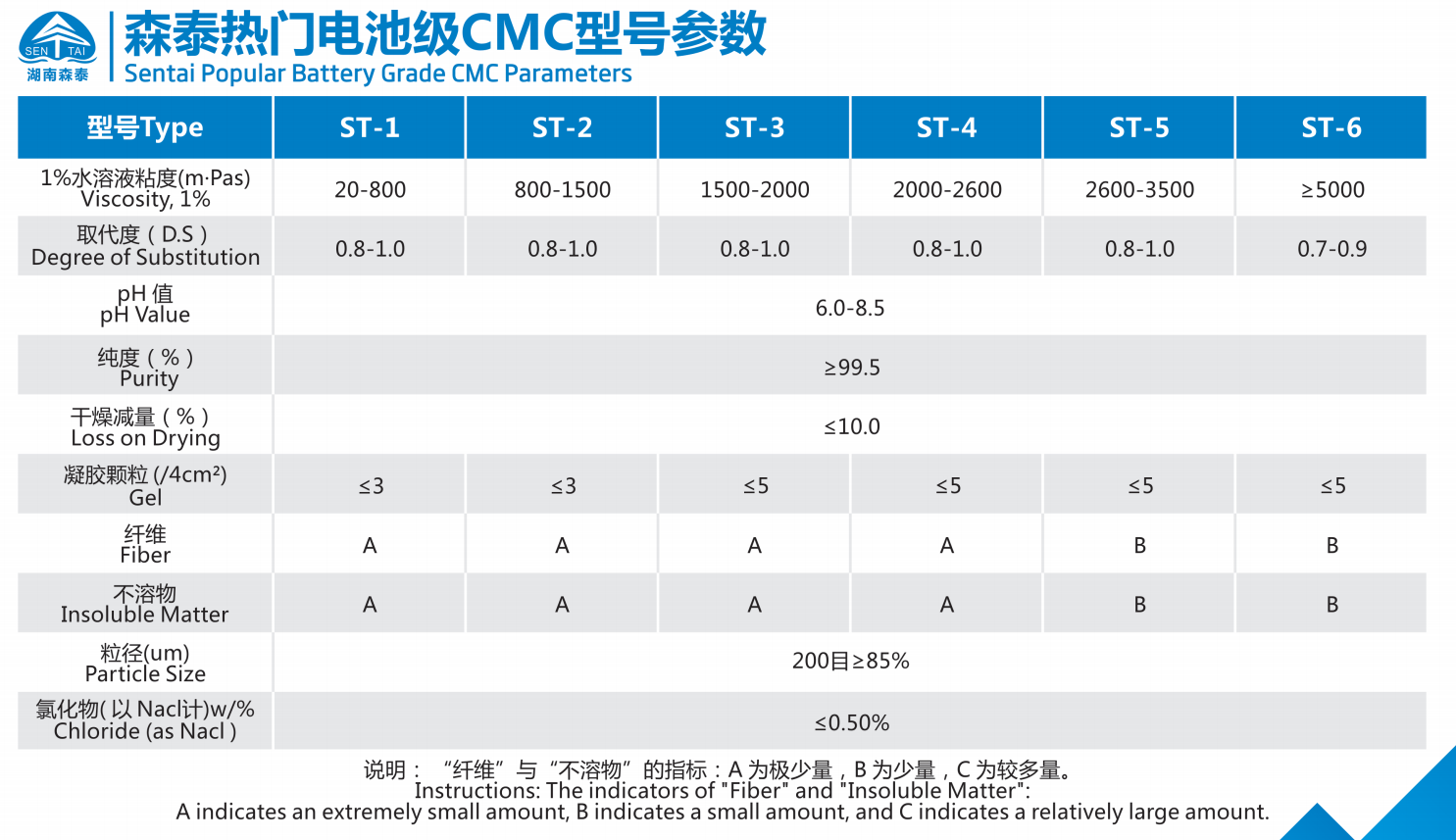
Applications in Battery Systems
1. Anode Binder
• Silicon-Dominant Anodes: Accommodates >300% volume expansion.
• Graphite Anodes: Enhances adhesion and reduces delamination.
2. Cathode Binder
• High-Ni NMC/LFP: Stabilizes structure during deep cycling.
• Sulfur Cathodes: Mitigates polysulfide shuttling.
3. Solid-State Batteries
• Compatible with ceramic/polymer hybrid electrolytes.
Certifications & Compliance
• ISO 9001: Quality Management
• IATF 16949: Automotive Quality Management Systems
• lSO 14001: Environmental Management
Why Sentai’s Battery-Grade CMC?
✅ Ultra-Low Impurities – Maximizes cell energy density and longevity.
✅ Custom Formulations – Tailored viscosity, DS, and particle size for specific electrode designs.
✅ Supply Chain Security – 10,000-ton annual capacity, global logistics.
✅ R&D Partnership – Sentai in accordance with the production processes of the battery industry and the specific performance requirements of product use, collaborates with universities and specialized chemical energy laboratories for continuous research and development. This collaboration aims to improve and introduce new generations of battery-grade products.
✅ Replace Imported CMC – The product has the characteristics of low additive amount, good stability, and excellent processing performance. Through application testing and comparison with imported CMC used by domestic battery industry users, it is evident that our company's product offers a high cost-performance ratio and demonstrates excellent performance in use.
Performance Comparison
Property | Sentai CMC | Conventional PVDF |
Solvent | Water | Toxic NMP |
Processing Cost | 30% lower | High VOC handling |
Adhesion Strength | 18–22 N/m | 12–15 N/m |
Cycle Life (Si-anode) | +200 cycles | Baseline |
Power the Future with Sentai!
Elevate your battery performance with our cutting-edge CMC technology. Request samples and technical data today.
Battery Grade CMC is an ultra-pure anionic carboxymethyl cellulose polymer engineered as a high-performance binder for lithium-ion battery electrodes. It is designed to support electrode adhesion, structural integrity, electrolyte stability, and water-based electrode processing.
In lithium-ion battery manufacturing, Battery Grade CMC helps bind active materials, conductive additives, and current collectors together. It is suitable for anodes, cathodes, and solid-state battery systems used in electric vehicles, consumer electronics, and renewable energy storage applications.
Battery electrodes need strong adhesion, stable dispersion, controlled impedance, and reliable structure during repeated charge and discharge cycles. Battery Grade CMC supports these requirements through its binding ability, water solubility, electrolyte stability, and low-impurity profile.
Compared with conventional PVDF binder systems that use NMP solvent, Battery Grade CMC supports water-soluble processing. This helps reduce the use of toxic NMP solvents and supports more eco-efficient battery electrode manufacturing.
Battery Grade CMC forms strong and flexible bonds between active materials and current collectors. It helps reduce cracking during charge cycles and supports electrode structural stability.
It is suitable for active material systems such as silicon anodes, graphite anodes, and NMC cathodes where adhesion and mechanical strength are important for battery performance.
Battery Grade CMC is designed to provide minimal impedance with electrolyte systems such as EC/DMC solvents. This helps support faster ion transfer and improved rate capability.
It also supports uniform distribution of conductive additives, including carbon black, helping maintain consistent electrode conductivity.
Battery Grade CMC is water-soluble and can be used to replace NMP-based PVDF binder systems in suitable electrode formulations. This supports cleaner processing, lower VOC emissions, and reduced solvent-related handling requirements.
Battery Grade CMC has low ash content, with the original product information listing low ash content below 0.1%. This helps prevent unwanted side reactions inside battery cells and supports cell energy density and longevity.
Battery Grade CMC provides electrochemical stability for battery electrode systems. The original application information lists voltage stability up to 4.5 V vs. Li/Li⁺ and temperature performance from -20°C to 80°C.
It also helps inhibit electrolyte decomposition at high voltages, supporting stable electrode performance in lithium-ion battery systems.
Battery Grade CMC can be used as a binder for lithium-ion battery anodes, including silicon-dominant anodes and graphite anodes.
In silicon-dominant anodes, Battery Grade CMC helps accommodate volume expansion during charge and discharge cycles. In graphite anodes, it enhances adhesion and reduces delamination.
Supports strong adhesion between active materials and current collectors
Helps reduce cracking during cycling
Accommodates silicon anode volume expansion
Enhances graphite anode adhesion
Helps reduce delamination
Supports stable electrode structure during repeated charge cycles
Battery Grade CMC can be used in cathode systems, including high-Ni NMC and LFP materials. It helps stabilize electrode structure during deep cycling.
It can also be used in sulfur cathodes, where it helps mitigate polysulfide shuttling.
Suitable for high-Ni NMC and LFP cathodes
Helps stabilize cathode structure during deep cycling
Supports electrode integrity under repeated cycling
Helps mitigate polysulfide shuttling in sulfur cathodes
Battery Grade CMC is also compatible with ceramic/polymer hybrid electrolytes, making it suitable for solid-state battery development and related electrode systems.
Compatible with ceramic/polymer hybrid electrolytes
Supports binder functionality in advanced battery systems
Helps maintain electrode structure in solid-state battery applications
Explore how Battery Grade CMC supports electrode adhesion, water-based processing, electrolyte stability, and lithium-ion battery performance in different battery systems.
Property | Battery Grade CMC | Conventional PVDF |
|---|---|---|
Solvent System | Water | Toxic NMP |
Processing Cost | 30% lower | High VOC handling |
Adhesion Strength | 18–22 N/m | 12–15 N/m |
Cycle Life, Si-Anode | +200 cycles | Baseline |
The original product information lists the following certifications and compliance items:
ISO 9001 Quality Management
IATF 16949 Automotive Quality Management Systems
ISO 14001 Environmental Management
Battery Grade CMC is designed with an ultra-low impurity profile to support battery cell energy density, stability, and longevity.
Sentai can tailor viscosity, DS, and particle size according to specific electrode designs and battery manufacturing requirements.
The original product information lists a 10,000-ton annual capacity and global logistics support, helping customers meet battery material supply needs.
Sentai collaborates with universities and specialized chemical energy laboratories according to battery industry production processes and product performance requirements. This supports continuous research, development, and improvement of new generations of battery-grade products.
The original product information states that Sentai Battery Grade CMC has low additive amount, good stability, and excellent processing performance. Through application testing and comparison with imported CMC used by domestic battery industry users, the product shows high cost-performance ratio and good performance in use.
Type | ST-1 | ST-2 | ST-3 | ST-4 | ST-5 | ST-6 |
|---|---|---|---|---|---|---|
Viscosity, 1% Solution (mPa·s) | 20–800 | 800–1500 | 1500–2000 | 2000–2600 | 2600–3500 | ≥5000 |
Degree of Substitution (DS) | 0.8–1.0 | 0.8–1.0 | 0.8–1.0 | 0.8–1.0 | 0.8–1.0 | 0.7–0.9 |
pH Value | 6.0–8.5 | 6.0–8.5 | 6.0–8.5 | 6.0–8.5 | 6.0–8.5 | 6.0–8.5 |
Purity (%) | ≥99.5 | ≥99.5 | ≥99.5 | ≥99.5 | ≥99.5 | ≥99.5 |
Loss on Drying (%) | ≤10.0 | ≤10.0 | ≤10.0 | ≤10.0 | ≤10.0 | ≤10.0 |
Gel (/4cm²) | ≤3 | ≤3 | ≤5 | ≤5 | ≤5 | ≤5 |
Fiber | A | A | A | A | B | B |
Insoluble Matter | A | A | A | A | B | B |
Particle Size | 200 mesh ≥85% | 200 mesh ≥85% | 200 mesh ≥85% | 200 mesh ≥85% | 200 mesh ≥85% | 200 mesh ≥85% |
Chloride, as NaCl (%) | ≤0.50 | ≤0.50 | ≤0.50 | ≤0.50 | ≤0.50 | ≤0.50 |
Note: For Fiber and Insoluble Matter indicators, A indicates an extremely small amount, B indicates a small amount, and C indicates a relatively large amount.
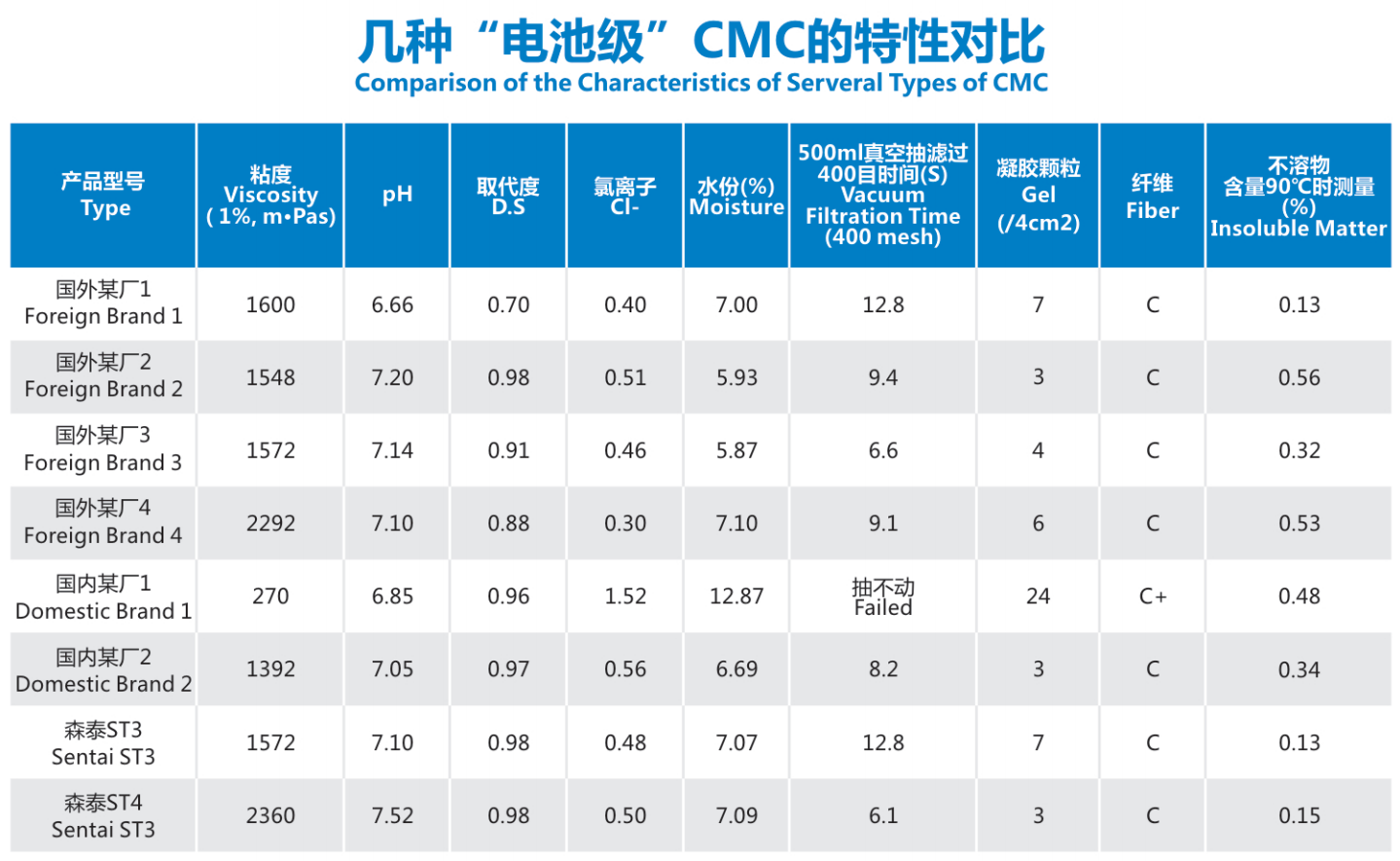
Product Type | Viscosity, 1% (mPa·s) | pH | DS | Cl⁻ | Moisture (%) | Vacuum Filtration Time, 500ml Through 400 Mesh (s) | Gel (/4cm²) | Fiber | Insoluble Matter, Measured at 90°C (%) |
|---|---|---|---|---|---|---|---|---|---|
Foreign Brand 1 | 1600 | 6.66 | 0.70 | 0.40 | 7.00 | 12.8 | 7 | C | 0.13 |
Foreign Brand 2 | 1548 | 7.20 | 0.98 | 0.51 | 5.93 | 9.4 | 3 | C | 0.56 |
Foreign Brand 3 | 1572 | 7.14 | 0.91 | 0.46 | 5.87 | 6.6 | 4 | C | 0.32 |
Foreign Brand 4 | 2292 | 7.10 | 0.88 | 0.30 | 7.10 | 9.1 | 6 | C | 0.53 |
Domestic Brand 1 | 270 | 6.85 | 0.96 | 1.52 | 12.87 | Failed | 24 | C+ | 0.48 |
Domestic Brand 2 | 1392 | 7.05 | 0.97 | 0.56 | 6.69 | 8.2 | 3 | C | 0.34 |
Sentai ST3 | 1572 | 7.10 | 0.98 | 0.48 | 7.07 | 12.8 | 7 | C | 0.13 |
Sentai ST4 | 2360 | 7.52 | 0.98 | 0.50 | 7.09 | 6.1 | 3 | C | 0.15 |
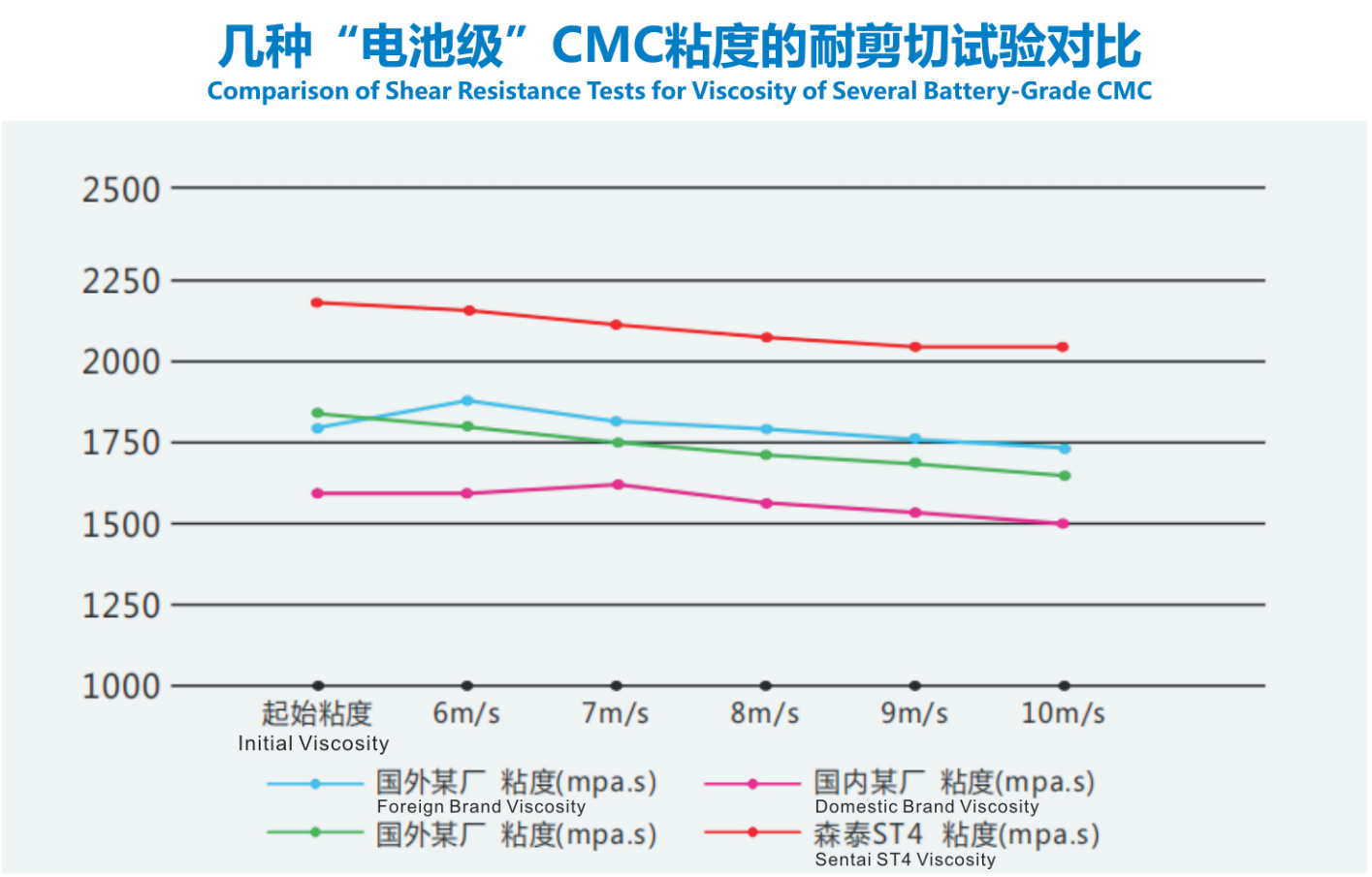
Sample | Initial Viscosity (mPa·s) | 6 m/s | 7 m/s | 8 m/s | 9 m/s | 10 m/s |
|---|---|---|---|---|---|---|
Foreign Brand 1 | ≈1790 | ≈1860 | ≈1810 | ≈1780 | ≈1750 | ≈1730 |
Foreign Brand 2 | ≈1830 | ≈1790 | ≈1750 | ≈1710 | ≈1680 | ≈1640 |
Domestic Brand | ≈1590 | ≈1590 | ≈1620 | ≈1560 | ≈1530 | ≈1500 |
Sentai ST4 | ≈2190 | ≈2170 | ≈2130 | ≈2090 | ≈2050 | ≈2050 |
Note: The data shows viscosity retention performance under different shear rates. Actual results may vary depending on test conditions and formulation systems.
Sentai provides customized CMC solutions according to customer requirements. For battery applications, customization is especially important because electrode systems may require different viscosity, DS, particle size, impurity control, ultra-low NaCl content, solubility, adhesion, dispersion behavior, and electrochemical stability.
For anode systems, customers may focus on adhesion strength, silicon expansion accommodation, graphite delamination control, conductive additive distribution, and slurry stability. For cathode systems, customization may focus on structure stability, electrolyte compatibility, low ash content, voltage stability, and cycling performance. For solid-state battery systems, customization may focus on compatibility with ceramic/polymer hybrid electrolytes and electrode structure retention.
Sentai can adjust CMC specifications based on application requirements, including DS, viscosity, particle size, ultra-low NaCl, enhanced solubility, and other specialized performance needs. The available customization range includes DS from 0.4 to 1.5, viscosity from 20 to 10,000 mPa·s, and particle size from 10 to 300μm.
Through collaborative development, application testing, process optimization, technical support, and full-process quality control, Sentai helps customers select and customize Battery Grade CMC products according to electrode design, slurry formulation, battery material system, production process, and target cell performance.
Battery Grade CMC is an ultra-pure anionic carboxymethyl cellulose polymer used as a binder for lithium-ion battery electrodes. It helps improve electrode adhesion, structural integrity, electrolyte stability, and water-based processing performance.
Battery Grade CMC is used in lithium-ion battery anodes, cathodes, and solid-state battery systems. It works as a binder to help active materials, conductive additives, and current collectors form stable electrode structures.
Yes. Battery Grade CMC can be used in silicon-dominant anodes and graphite anodes. It helps accommodate silicon anode volume expansion, enhances adhesion, and reduces delamination.
Yes. Battery Grade CMC can be used in high-Ni NMC, LFP, and sulfur cathode systems. It helps stabilize structure during deep cycling and helps mitigate polysulfide shuttling in sulfur cathodes.
Yes. The original product information states that Battery Grade CMC is compatible with ceramic/polymer hybrid electrolytes, making it suitable for solid-state battery systems.
Battery Grade CMC uses water as the solvent system, while conventional PVDF uses toxic NMP. The original product comparison also lists lower processing cost, higher adhesion strength, and improved cycle life for Si-anode systems.
Low ash content helps reduce unwanted side reactions inside battery cells. The original product information lists low ash content below 0.1%.
The original product information states that Battery Grade CMC provides minimal impedance with EC/DMC electrolyte solvents and helps support faster ion transfer and rate capability.
Yes. Sentai can customize Battery Grade CMC according to customer requirements, including viscosity, DS, particle size, ultra-low NaCl content, solubility, adhesion, dispersion behavior, and electrochemical stability.
Yes. Sentai provides collaborative development, application testing, process optimization, technical support, and full-process quality control to help customers select and customize Battery Grade CMC for electrode and battery system requirements.
